


The Mongolian steppe
Our horsehair comes from steppe herds in Mongolia, collected by herding families during seasonal grooming. The coat gets tended anyway — the hair is the byproduct.
Free gift removed — your bundle no longer qualifies.
Real horsehair bristles on a bamboo handle. Every other “eco” brush fixed the handle and left nylon where it touches your teeth.
Four brushes in the box — a month each. It costs more than a plastic brush. That’s the whole point.
Not vegan — real animal hair, said plainly.
1Pick your bristle
2How many people use it?
Sold out — pick another.
Sold out — pick another.
Sold out — pick another.
Sold out — pick another.
Sold out — pick another.
Sold out — pick another.
3How should we send it?
Couldn't load pickup availability

“I've bought three 'eco' brushes and only found out afterward the bristles were still nylon. This is the first one where the part touching my teeth actually isn't plastic. Took me two days to get used to how soft it is — now I don't notice.”

“Softer than I expected, and yeah you have to stand it up to dry. Gave it a week and now I reach for it over my electric. They say right on the page it's not vegan, so no surprises there.”

“My dentist told me to ease off after my gums started receding. First natural brush that didn't feel like a gimmick — genuinely soft, and no plastic taste.”
In the box
Details
Not vegan — the bristles are natural animal hair. Not a medical device.
Questions? info@orinhealth.com
Brush with it for 60 nights. The whole family. If it isn't softer, cleaner, honestly better than what's in your bathroom now, email us and we refund it — keep the brush.
Unused, unopened returns accepted within 30 days for any reason.
Start a return: email info@orinhealth.com with your order number.


Yes — and it doesn't ask anything unusual of you. What lifts plaque is time and contact at the gum line, not force. Wet it under warm water first (natural bristle softens as it takes water), work in small circles for the full two minutes, then stand it up to dry. That's the whole technique, and it's on the card in the box.
Batch121: every batch is steam-sterilised at 121°C for four hours, then UV-treated, before it is ever assembled. The brush is put together and lab-tested in the USA for lead, heavy metals and microbial safety.
KilnCore handles it: the bamboo is kiln-carbonised — baked until the sugars and starch mould feeds on are gone — then sealed. Your part takes ten seconds: rinse, shake, stand it upright. Sealed wet in a travel case, any natural bristle can hold moisture, so give it air.
About a month — sooner than the three to four months dentists give a nylon brush. Natural bristle wears honestly and softens when it is done, which is exactly why the box holds four. What you stop adding to the bin each time is a plastic handle and plastic bristles.
Free U.S. shipping, dispatched in 1–2 business days, in paper packaging. Brush with it for 60 nights — if it isn't honestly better than what's in your bathroom now, email us and we refund it, keep the brush. Unused, unopened returns accepted within 30 days too.
You switched to bamboo to get plastic out of your mouth. The handle never touched your teeth. The bristles do — and on almost every “eco” brush they're still nylon. “Plant-based” usually means Nylon-1010.
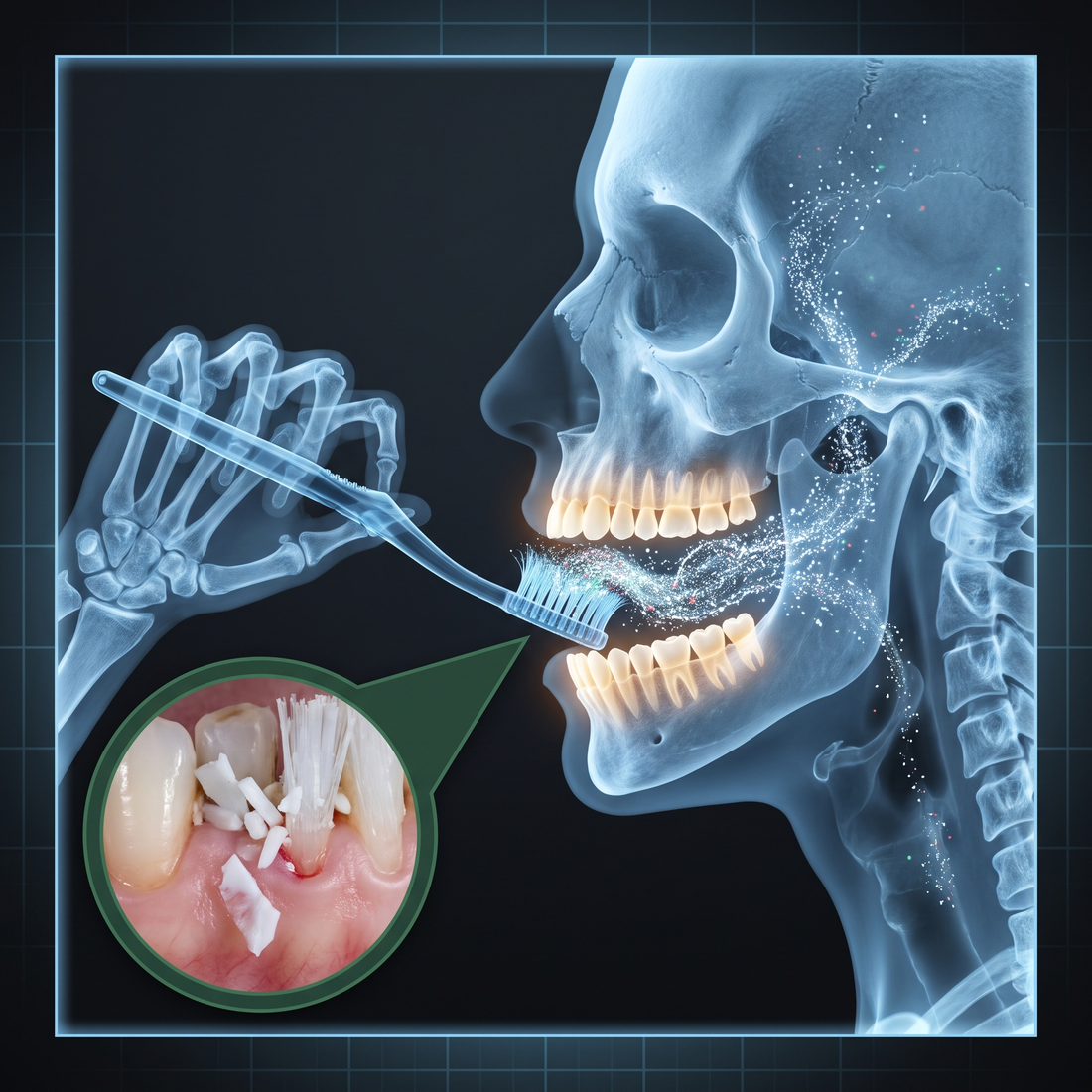
Stiff nylon scrubs the gum line back a little at a time — and gum doesn't grow back.
As the bristles fray they shed microplastic into tissue that absorbs faster than almost anywhere in your body.
Lab-measured: plastic bristles shed up to 2.3 million microplastic particles a year (2025). Young science — we cite it to size the problem, not to promise a cure.
You bin the brush every month. What it leaves behind doesn't leave.
Natural bristle removes the source. No nylon on your gums, none in the bin, none shedding into you.
Every stroke turns the brush into a microplastic delivery system. As the bristles degrade they release shards laced with BPA and phthalates — chemicals linked to hormone disruption and chronic disease. Those fragments get absorbed, and have been found in the bloodstream, circulating through vital organs.
Once inside, they don’t just pass through. They accumulate — triggering oxidative stress, weakening the immune system, and disrupting gut and hormone balance. Research links long-term exposure to chronic inflammation, fatigue, and even infertility — from something as ordinary as brushing your teeth.
Findings above are from published research on microplastics and plastic additives generally, not studies of this product. OrinHealth makes no medical claim.
Horsehair is keratin — the same protein as your own hair, so there is nothing to shed. Pressure-set into kiln-carbonised bamboo with zero glue. Free from BPA, phthalates and microplastic shedding, biodegradable top to bottom. Not “plant-based nylon”.
You stop feeding one more source of synthetic material into your body every morning — without giving anything up, and without changing a thing about your routine.
Most natural brushes go quiet about sourcing, and you're right to read silence as a warning. So here's the route, stop by stop, on the record.
Our horsehair comes from steppe herds in Mongolia, collected by herding families during seasonal grooming. The coat gets tended anyway — the hair is the byproduct.

No animal is raised or hurt for a toothbrush. If a supplier can't show us how the hair was collected, we don't buy it.

Every batch is steam-sterilised at 121°C for four hours, then UV-treated — so ‘natural' never means ‘unclean'.

Tested for lead, heavy metals and microbial safety before a single box ships. Not a $2 marketplace rebrand with a new logo.

The handle is baked until the sugars and starch mould feeds on are gone, then sealed against water. It ships with an upright stand — rinse, shake, stand it up and it stays dry.
Four steps between a Mongolian steppe and your sink. Each has a name because each has a number you can check.
Every bristle keeps the tip it grew.
Nylon is an extruded tube — cut flat, then machine-rounded into a cap. Ours is never cut, so the point at the end is the one the hair grew.
Baked until there is nothing left to feed mould.
The handle is kiln-carbonised — the sugars and starch mould actually eats are driven off — then sealed against water.
Forty tufts, pressure-set.
Most brushes anchor each tuft with a metal staple and a drop of adhesive. Ours are pressed into the bamboo under load.
Steam-sterilised before assembly.
Every batch carries its own paperwork — so 'natural' never has to mean 'unclean'.
Sample figures for layout only — replace with your signed third-party certificate (real batch, lab name and date) before publishing or advertising.
Your order arrives in paper. It would have been a strange way to ship a plastic-free brush.
Same carbonised handle, same zero plastic, same 40 tufts. The hair is the only variable — so here's what each one feels like before you commit to one.
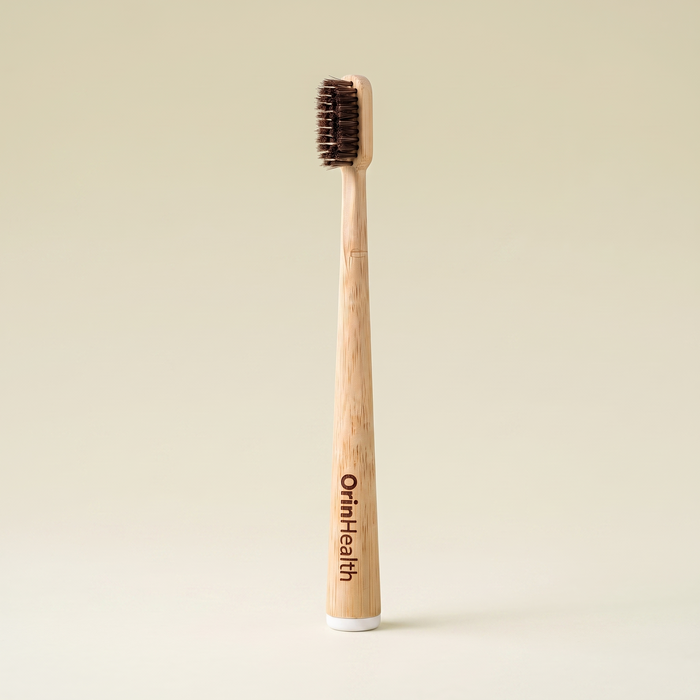
Keratin — the same protein as your own hair — and the softest natural bristle there is. TrueTaper — each strand keeps the tapered tip it grew, so it bends along the gum line instead of scraping across it.
Pick this if a dentist has flagged recession, your gums ache after a firm nylon scrub, it's your first switch off nylon, or it's for the kids.
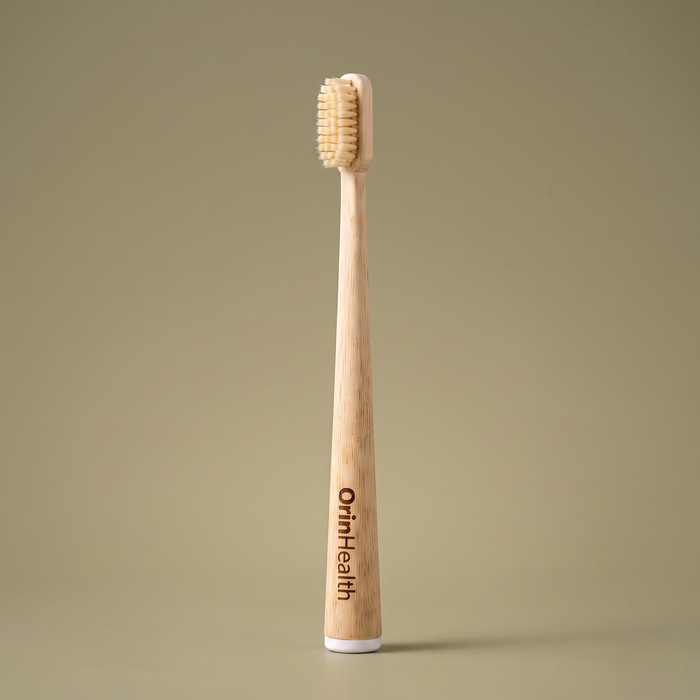
Thicker, springier keratin for people who like that just-scrubbed friction. Stiff for the first few days, then it breaks in like a shaving brush.
Pick this if you use a medium-firm nylon brush today, you want to feel the clean, and recession has never been flagged.
Not sure? Take the horsehair. It's the safe default — and you can go firmer next month.
Pick your bristleMost people overthink this. Answer three and we'll point you at the one that suits your mouth — no email, no quiz funnel.
The drugstore one, the bamboo one, the electric one — and Kindred. Same job. Four very different materials in your mouth.
| Feature | This oneKindred | Drugstore nylon | “Eco” bamboo | Electric |
|---|---|---|---|---|
| What touches your teeth | Real horsehair | Petroleum nylon | Still nylon | Nylon head |
| Microplastics in your mouth | None, ever | Every brush | Every brush | Every brush |
| Gentle on gums | Softest natural | Abrasive | Abrasive nylon | Often too hard |
| Actually biodegradable | Handle & bristle | No | Handle only | No |
| Assembled & lab-tested in the USA | Yes | Usually overseas | Often a rebrand | Overseas |
| If it's not for you | 60 nights, refunded | You bought it | You bought it | You bought it |
One swap. Nothing plastic where it counts.
Free U.S. shipping · 60 nights to decide — keep it or get refunded.
I used to have a very ordinary family. A wife I loved. Four children. A home that was never truly quiet.
Then my wife became sick. Doctor visits, tests, medications, long nights in hospital rooms. Eventually, I lost her — and overnight, I became a father raising four children on my own.
After her passing, I started researching what we’re exposed to every day: chemicals in household products, microplastics in things we once assumed were harmless. I couldn’t change the past. But every time I looked at my four children, I kept thinking:
“If there’s anything I can do to reduce what they’re unnecessarily exposed to, I have to do it.”
So I started changing what we used at home — and ran into another problem. Everything was labeled “clean,” “safe,” or “non-toxic,” yet the deeper I looked, the harder it became to know who I could actually trust. So I stopped searching, and started creating the products I wished existed for my own children. That is how OrinHealth was born — not in a boardroom, but from a promise made by a father.
I may not be able to protect my children from everything. But I can be more careful about what I bring into our home. And if something isn’t good enough for my own children, it will never be good enough for your family either.

A family of four puts a bristle in a mouth eight times a day. That is the number this brush was built around — not a shelf, not a trend.
The soft horsehair is gentle enough for small mouths, and the part they chew on isn’t plastic. One box covers one person for four months — or the whole family for one.
Pick 2 or 3 boxes in the selector above — the Silk Floss comes free from two.
Cover the houseEveryone below treats mouths for a living — including the parts they'd warn a patient about.
 Dr. Anthony Vega, DDS
🇺🇸Periodontics · Denver, CO
Dr. Anthony Vega, DDS
🇺🇸Periodontics · Denver, CO
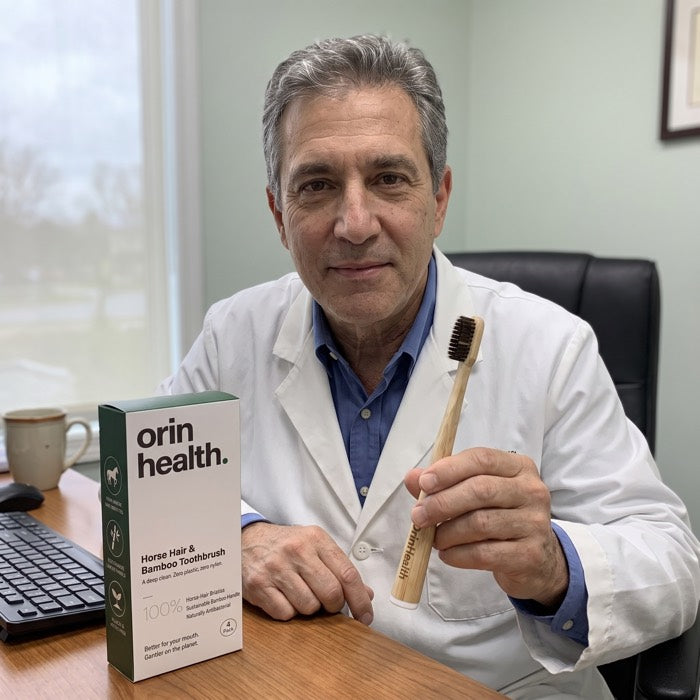
When a patient shows wear at the gumline I check what's in their hand before I lecture them about method. Most of the nylon labelled soft in my chair is not soft. These filaments give way before they load the tissue, which is the behaviour I actually want out of a bristle. The hand still matters more than the handle — I tell everyone that.
 Denise Okonkwo, RDH
🇺🇸Dental hygienist · Austin, TX
Denise Okonkwo, RDH
🇺🇸Dental hygienist · Austin, TX
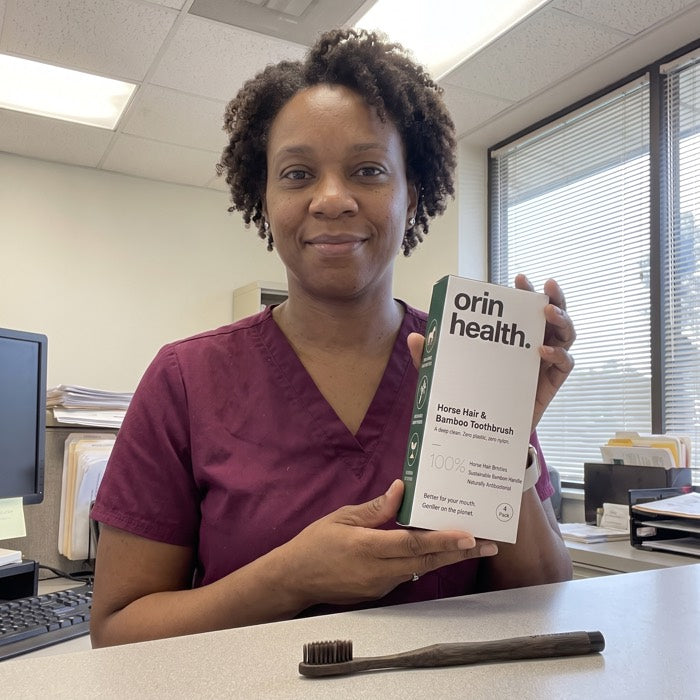
Stiff nylon gives you feedback that feels like cleaning — scrub harder, feel more happening. Patients read that as the brush working. A softer filament takes the reward away, so the pressure drops on its own without me nagging. That is the behaviour change I have been arguing for since I qualified.
 Dr. Elena Marchetti, DMD
🇺🇸General dentistry · Portland, OR
Dr. Elena Marchetti, DMD
🇺🇸General dentistry · Portland, OR
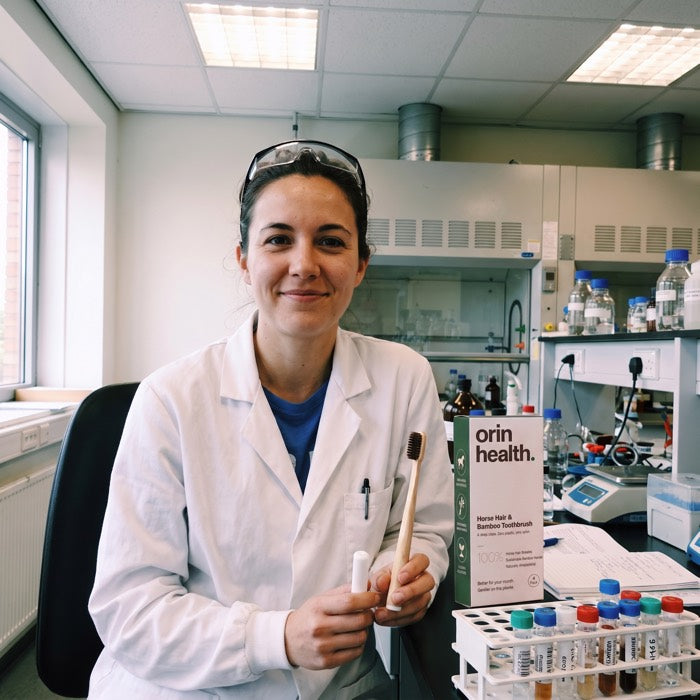
For someone who winces through a cleaning I want the gentlest thing that still disturbs plaque, and this qualifies. It is not a treatment and I do not present it as one — sensitivity has causes a toothbrush cannot fix. But it is a reasonable thing to send them home with while we work out what is actually going on.
 Dr. Hana Whitfield, DDS
🇺🇸Restorative · San Diego, CA
Dr. Hana Whitfield, DDS
🇺🇸Restorative · San Diego, CA

These are two different brushes, not two colours of the same one. The boar has real resistance and suits someone with a light hand who wants to feel the surface being cleaned. Anyone with recession I would put on the horsehair instead, no debate — and to the page's credit it says so in three separate places before you can even pick one.
 Dr. Samuel Lindqvist, DDS
🇺🇸General dentistry · Atlanta, GA
Dr. Samuel Lindqvist, DDS
🇺🇸General dentistry · Atlanta, GA

Patients ask, so I will answer plainly: a bristle does not change the colour of a tooth, and no toothbrush treats gum disease. What this one does is stop putting nylon against the tissue and make heavy brushing less satisfying to do. That is a narrow claim. It is also the only honest one, and I would rather a brand made it than the usual noise.
Sourcing, the vegan question, the smell, your kids, your electric brush.
Still unsure? Email info@orinhealth.com — a real person answers, usually within a day.
Horsehair (Soft) is the gentlest — for sensitive gums, recession, kids, and most first-timers. Boar (Regular) is thicker and springier, with a firmer scrub, and takes a few days to break in. Same handle, same zero plastic, both keratin.
The head on every electric brush is still nylon — same microplastics, and a fresh plastic head every few months. Electric brushes also make it easy to press too hard, a leading cause of gum recession (it's why they now build in pressure sensors). A soft manual bristle sidesteps both. Love the routine of your electric? Keep it — just know the part in your mouth hasn't changed.
A couple of loose hairs on the very first rinse is normal for any natural bristle — run it under the tap before you brush and they are gone. After that it should not shed, because the forty tufts are pressed in under load rather than glued or stapled. If yours keeps shedding, it is a faulty brush: tell us inside the 60 nights and you are refunded, brushes kept.
Bleeding gums are worth a dentist's eyes, and nothing here treats them. What dentists usually ask for is a softer bristle and less pressure, and horsehair is the softest natural bristle we can source — the taper bends along the gum line instead of scraping across it. It is a gentler tool, not a treatment.
Then take Boar (Regular). It is thicker and springier, gives a firmer scrub, and takes a few days to break in before it settles. Horsehair (Soft) is the other end of the range on purpose. Both are keratin, both sit on the same bamboo handle.
Horsehair — no. Boar can carry a faint natural scent on first use; rinse it in hot water before your first brush and it's gone within a day or two. It's hair, not plastic, and it behaves like it.
Yes — the soft horsehair is gentle enough for small mouths, and the part they chew on isn't plastic. Supervise little ones brushing, same as with any toothbrush.
Then it stays damp, and that is the one thing keratin does not like. Rinse it, shake it, and stand it up in open air — that is what the drying stand is for. Travelling, take the cap off once you land. This is the honest maintenance cost of a natural bristle and we would rather say it than let you find out.
No. Use whatever you use now, fluoride included. Nothing about the brush asks you to change the rest of your routine.
Ask whoever fitted them — that call is theirs, not ours. Generally a soft bristle is the gentle end of the range, and like any toothbrush this does not replace floss or interdental brushes.
Bamboo handle, keratin bristles, no glue and no metal staples holding the tufts in — so there is nothing to prise out first. That is what "no staples" actually buys you: the whole brush goes where your food scraps go, instead of a plastic stick that outlives you.
No. It's real animal hair, and we say that plainly rather than hope you don't ask. If that's a dealbreaker, we'd honestly rather you know now.
The horsehair comes from steppe herds in Mongolia, collected by herding families during seasonal grooming — no animal is raised or harmed for it. It's then steam-sterilised at 121°C and UV-treated, and the brush is assembled and lab-tested in the USA. Every batch carries its sourcing and sterilisation paperwork — email us and we will send it.
Yes. Your order arrives in paper, with no plastic mailer. It would have been a strange way to ship a plastic-free brush.
Assembled and lab-tested in the USA. The horsehair itself is Mongolian, because that is where the coat is right for this — we are not going to pretend a horse in Montana grew it. Every batch is tested for lead, heavy metals and microbial safety before a box ships.
It does, and that brush is cheaper. Dentists say to replace it every three to four months, most people stretch it far longer, and every head you bin is a lifetime subscription to microplastics. A box here is four months of brushing for one person — under $9 a month — and what you are paying the difference for is the part that actually goes in your mouth.
Then you are covered. Brush with it for 60 nights and if it is not honestly better than what is in your bathroom now, email us: we refund it and you keep the brushes. Pick the one that sounds right — the guarantee is there for being wrong.
No. Subscription is pre-selected in the box above — tick “One-time purchase” to buy once instead. Either way it ships free, and one box is four months of brushing for one person. [XÁC NHẬN TRƯỚC KHI CHẠY ADS: chu kỳ tính tiền lại và cách huỷ/tạm dừng]
Still thinking? Take 60 nights.
You don't have to decide today. Take the box home, use it for two months, and let the brush make the argument instead of this page.
