OrinHealth™ Kindred · Assembled & lab-tested in the USA

Your bamboo toothbrush still has plastic bristles.

Bamboo fixed the handle — the part that was never in your mouth. Kindred uses real horsehair or boar on that bamboo: four brushes, four months, nothing synthetic where it touches your teeth.

  • Real horsehair or boar — never nylon, never “plant-based” nylon.
  • Bamboo handle, kiln-carbonised so it won’t go mouldy.
  • Four brushes in the box — one a month, then you’re done thinking about it.
The honest guarantee
60 nights. Keep it or refund it.Not honestly better than what's in your bathroom now? We refund it — and you keep the brushes.
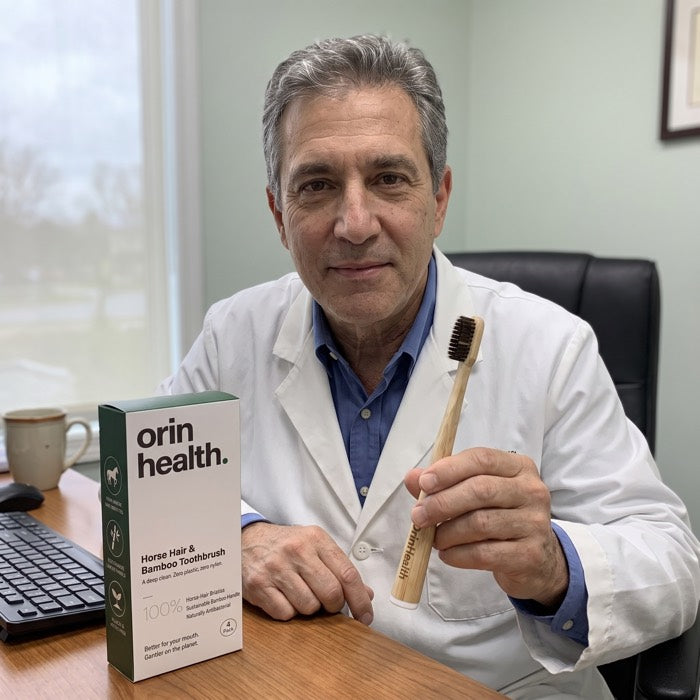
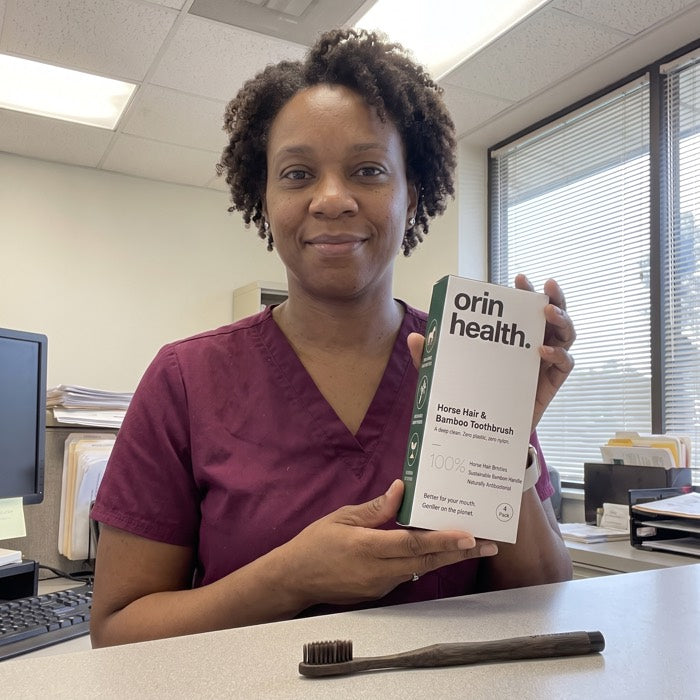
4.6· 5 clinician reviews
  • Plastic-free bristles
  • 60-night refund
  • Assembled & lab-tested in the USA
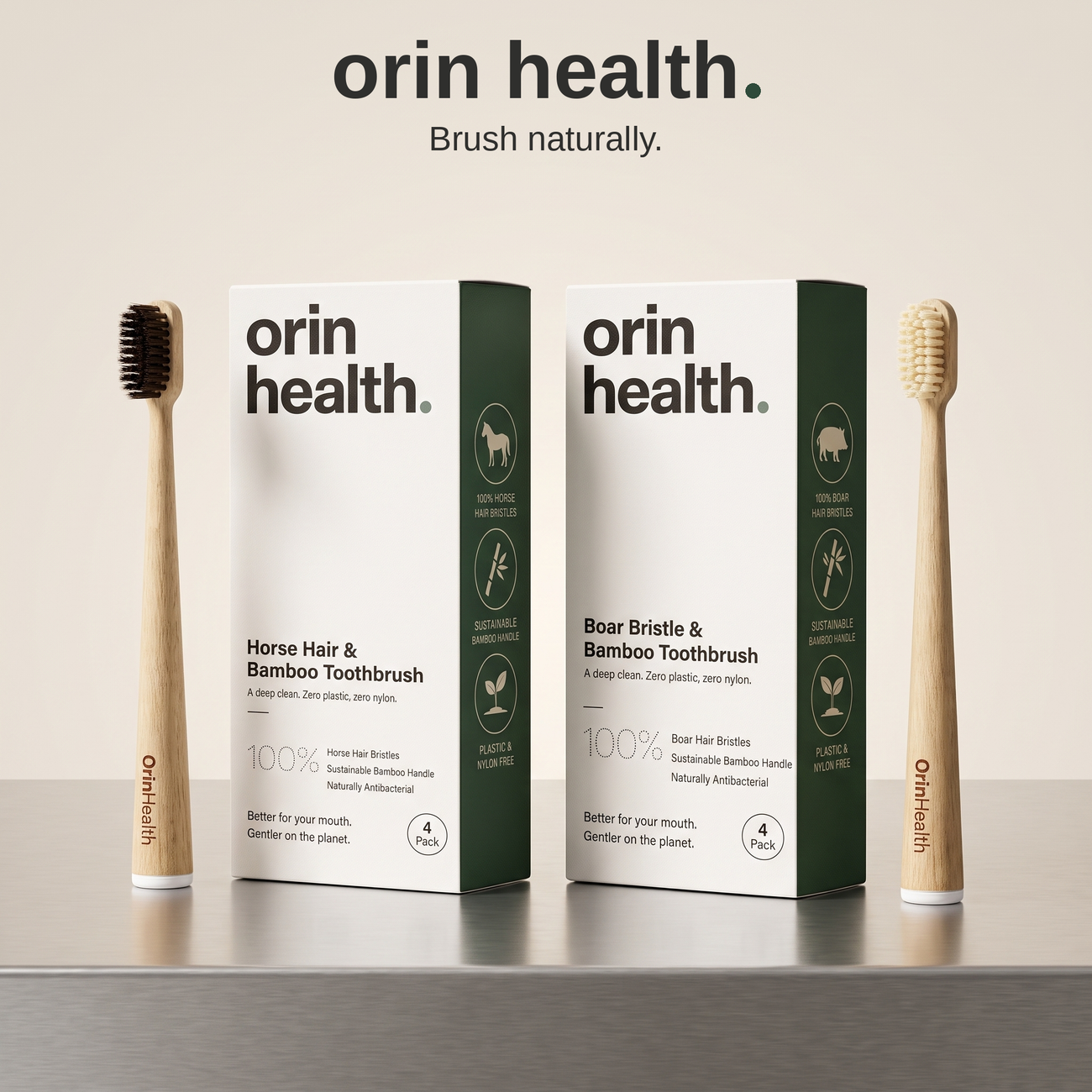
OrinHealth Kindred — bamboo toothbrush with natural horsehair bristles
1938 the year nylon replaced natural bristle
2.3M microplastic particles a nylon brush can shed in a year
0nights to decide, or send it back
How we got here

Natural bristle didn’t lose. It just couldn’t be patented.

1938The year a chemical company put nylon in your mouth — and nobody has taken it out since.88years later, the part in your mouth still hasn’t changed

For centuries a toothbrush meant natural bristle — boar, horse, badger. It cleaned teeth perfectly well. Its only commercial flaw was that nobody could own it.

In 1938 DuPont had just patented nylon. Dr. West’s Miracle-Tuft put it on a brush head, and within a decade natural bristle was gone from every shelf in America. Not because it cleaned worse. Because the replacement had an owner, a factory and a margin.

Decades later the handle finally changed. Bamboo, cork, recycled plastic — brands fixed the part you hold. The part that goes in your mouth is the same 1938 idea.

We didn’t invent anything. We went back to the bristle that worked before plastic became the more profitable answer.

  1. Pre-1938 Boar, horse, badger. Natural keratin, no patent, no owner.
  2. 1938 Nylon arrives. Cheap to make, easy to patent, impossible to compost.
  3. 2015→ Bamboo handles everywhere. Bristles stay nylon.
  4. Today Kindred puts the bristle back where it started.

Dr. West’s Miracle-Tuft, 1938 — the first nylon-bristle toothbrush, using DuPont’s newly patented nylon.

Check it yourself

Go read the packet your brush came in.

It says bamboo handle in large type. Then, in small type, it says nylon bristles — or “plant-based nylon”, which is still nylon. That is the half of the brush that actually goes in your mouth, twice a day, for as long as you own it.

What almost every packet says

Nylon bristles

A worn nylon toothbrush head with frayed bristles shedding microplastic particles
In your mouth twice a day

Petroleum plastic spun into filaments. “Plant-based nylon” and PBT are the same family — the plant part is the feedstock, not the plastic. It frays as it wears, and the frayed ends go somewhere. A bamboo handle changes none of this.

What this packet says

Horsehair or boar bristles

Close-up of the OrinHealth bamboo toothbrush head with natural horsehair bristles set into drilled holes
In your mouth twice a day

Keratin — the same protein as your own hair and nails. One whole fibre, tapered by the animal rather than cut flat by a machine. Nothing to shed as microplastic, and it composts when the brush is done.

Why we botheredA 2025 study in Ecotoxicology and Environmental Safety found plastic bristles can shed up to 2.3 million microplastic particles a person a year. The health research is still young — so we are not selling you a cure, just a brush with no plastic in the part that touches you.

The OrinHealth Kindred box holding four bamboo toothbrushes
One box · four months
What actually arrives

Four brushes, a stand, and a card. That’s the whole box.

Nothing in here is padding. The fourth brush is not a bonus — it is month four. And the stand is not an accessory: natural bristle has to dry upright or it stays damp, so we ship the thing that makes the brush work instead of selling it separately.

  • bamboo brushesHorsehair (soft) or boar (regular) — you pick one bristle for the whole box. A natural bristle gives you about a month of honest work before it softens, which is exactly why there are four.
  • upright drying standNatural bristle holds moisture. Standing it up is the difference between a brush that lasts a month and one that smells by week two. Included, not upsold.
  • two-minute care cardPrinted on paper, never plastic. How to break the bristle in, how to dry it, and what to do with the handle when the box is done.
About the price

A drugstore brush is two dollars and dentists say to replace it every three to four months. Natural bristle wears faster — one brush a month — so a $35 box covers four. Over a year that is more money than plastic, and we would rather say so plainly than hide it behind a per-day figure. What you are paying for is what the bristle is made of.

Pick your bristle
The part everyone thinks

“Animal hair? In my mouth?” The answer is boring: it’s hair.

That reaction is fair and we would rather meet it here than let you sit with it. So here is exactly what the bristle is, where it came from, and what happens to it — with the uncomfortable part left in.

It is keratin

The same protein as your own hair, your fingernails and the lining of your mouth. Not a lab-spun approximation of it — the actual material.

It has been sterilised

Steam at 121°C for four hours, then UV, every batch. A longer cycle than the one running on the instruments at your last cleaning.

The tip is tapered, not cut

The animal grew a fine point. Nylon is extruded as a tube and sliced flat, which is why the ends are square — and why brushing hard with it hurts.

It goes back to nothing

Bury the head and in a year there is nothing to find. The nylon head from the brush you used in 2015 is still intact somewhere.

Said plainly Yes, it is an animal product, so Kindred is not vegan. The hair is collected during seasonal grooming from herds that are tended anyway — no animal is raised or hurt for a toothbrush. If that is still a dealbreaker, it is a real one, and we would rather you skip the box than find out after it arrives.

Who it’s for — and isn’t

Kindred is not for everyone. That is deliberate.

Most brands will tell you their thing suits you whoever you are. We would rather you buy the right brush, even when that is not this one — a returned box helps nobody, and a disappointed customer least of all.

This is for you if
  • Your gums have started receding, or a hygienist has told you that you brush too hard.
  • You already switched to bamboo, then found out the bristles were nylon the whole time.
  • You care where the plastic actually sits — in the bristle, not the handle.
  • Every brush labelled “soft” you have tried still felt like scrubbing.
  • You would rather buy four at once and stop thinking about toothbrushes for a while.
  • You are fine with an animal product if nothing was raised or harmed to make it.

None of that is reverse psychology. If Kindred is not right for you, we genuinely hope you find the one that is.

Why this brand exists

This did not start in a boardroom. It started with a promise.

I used to have a very ordinary family. A wife I loved. Four children. A home that was never truly quiet.

Then she became sick, and eventually I lost her — and overnight I became a father raising four children on my own. Afterwards I started reading about what we bring into a house without thinking: the chemicals, the microplastics in things we assumed were harmless. I could not change the past. But every time I looked at those four, the same sentence kept coming back.

“If there is anything I can do to reduce what they are needlessly exposed to, I have to do it.” Everything on the shelf said clean, safe, non-toxic — and the deeper I read, the less I knew who to trust. So I stopped looking and started making the things I wanted for my own children. That is where OrinHealth came from.

I cannot protect my children from everything. I can be careful about what I bring into our home — and if something is not good enough for them, it does not get sold to you.

FounderOrinHealth
OrinHealth founder with his four children
The clinician panel

We sent it to dentists. They kept the criticism in.

Three of the five who tried it. The full panel, filters and all, sits on the product page.

4.6 out of 5 · 5 clinician reviews
Dr. Anthony Vega, DDS Periodontics · Denver, CO

The brush is the first thing I look at, not the technique

Dr. Anthony Vega, DDS
Gum recession

When a patient shows wear at the gumline I check what's in their hand before I lecture them about method. Most of the nylon labelled soft in my chair is not soft. These filaments give way before they load the tissue, which is the behaviour I actually want out of a bristle. The hand still matters more than the handle — I tell everyone that.

Denise Okonkwo, RDH Dental hygienist · Austin, TX

It stops rewarding a heavy hand

Denise Okonkwo, RDH
Brushing pressure

Stiff nylon gives you feedback that feels like cleaning — scrub harder, feel more happening. Patients read that as the brush working. A softer filament takes the reward away, so the pressure drops on its own without me nagging. That is the behaviour change I have been arguing for since I qualified.

Dr. Samuel Lindqvist, DDS General dentistry · Atlanta, GA

It will not whiten anything, and I want that said out loud

Dr. Samuel Lindqvist, DDS
What it won't do

Patients ask, so I will answer plainly: a bristle does not change the colour of a tooth, and no toothbrush treats gum disease. What this one does is stop putting nylon against the tissue and make heavy brushing less satisfying to do. That is a narrow claim. It is also the only honest one, and I would rather a brand made it than the usual noise.

Before you click through

Five things people ask before they trust a toothbrush brand.

The product page answers everything about the brush itself. These are the ones that come up first.

Still unsure? Email info@orinhealth.com — a real person answers, usually within a day.

How is this different from the bamboo brush I already own?

The handle is the same idea — ours is bamboo too. The difference is the bristle. Turn your packet over: it almost certainly says nylon, or “plant-based nylon”, which is nylon. Ours says horsehair or boar. That is the only half we changed — and the only half that was ever the problem.

Which bristle do I pick?

Horsehair if your gums are sensitive or receding, if you are a first switcher, or if it is for a child — it is the softer of the two. Boar if you like to feel the brush working and your gums are fine. Both sit on the same bamboo handle with the same zero plastic. There is a three-question matcher on the product page if you would rather not guess.

Do I have to subscribe?

No — but you should know that Subscription is pre-selected on the product page, so check before you pay. Tick “One-time purchase” and it becomes a single box of four at $35 instead of $29.75. If you do keep the subscription, you can skip or cancel from the first email, and we will not make that hard.

Where does it come from?

The horsehair is collected during seasonal grooming from herds on the Mongolian steppe — tended anyway, nothing raised or hurt for a toothbrush. Every batch is steam-sterilised at 121°C and UV-treated, then assembled and lab-tested in the United States. The full route, stop by stop, is on the product page.

What if I don’t like it?

Email us inside 60 nights and we refund the order. You keep the brushes — posting used toothbrushes back helps nobody, and we would rather absorb that than run a returns process for it. No form, no restocking fee, no asking you to prove anything.

One thing left to decide

That is the whole argument. The rest is picking a bristle.

Horsehair if your gums are sensitive or receding. Boar if you want to feel it working. Same bamboo handle, same nothing-plastic where it counts.

Pick your bristle Four brushes a box, one a month. Ships from the U.S. within 24 hours.
60 nights to change your mind · we refund it and you keep the brushes
  • Amazon
  • American Express
  • Apple Pay
  • Bancontact
  • Diners Club
  • Discover
  • Google Pay
  • iDEAL Wero
  • Mastercard
  • PayPal
  • Shop Pay
  • Visa