


Two of these are plastic. We put our own downside in the table.
Floss spends thirty seconds between your teeth and the rest of forever in the ground. Here is what the three common fibres actually are — including the row where ours loses.
| Feature | OURSSilk (this one) | Nylon floss | PTFE / “glide” floss | Electric |
|---|---|---|---|---|
| Fibre | 100% mulberry silk — a protein | Nylon — petroleum plastic | PTFE — the Teflon family | |
| Coating | Candelilla wax, from a plant | Usually paraffin, from petroleum | None needed — PTFE is the slip | |
| After the bin | Biodegradable | Doesn't break down | Doesn't break down | |
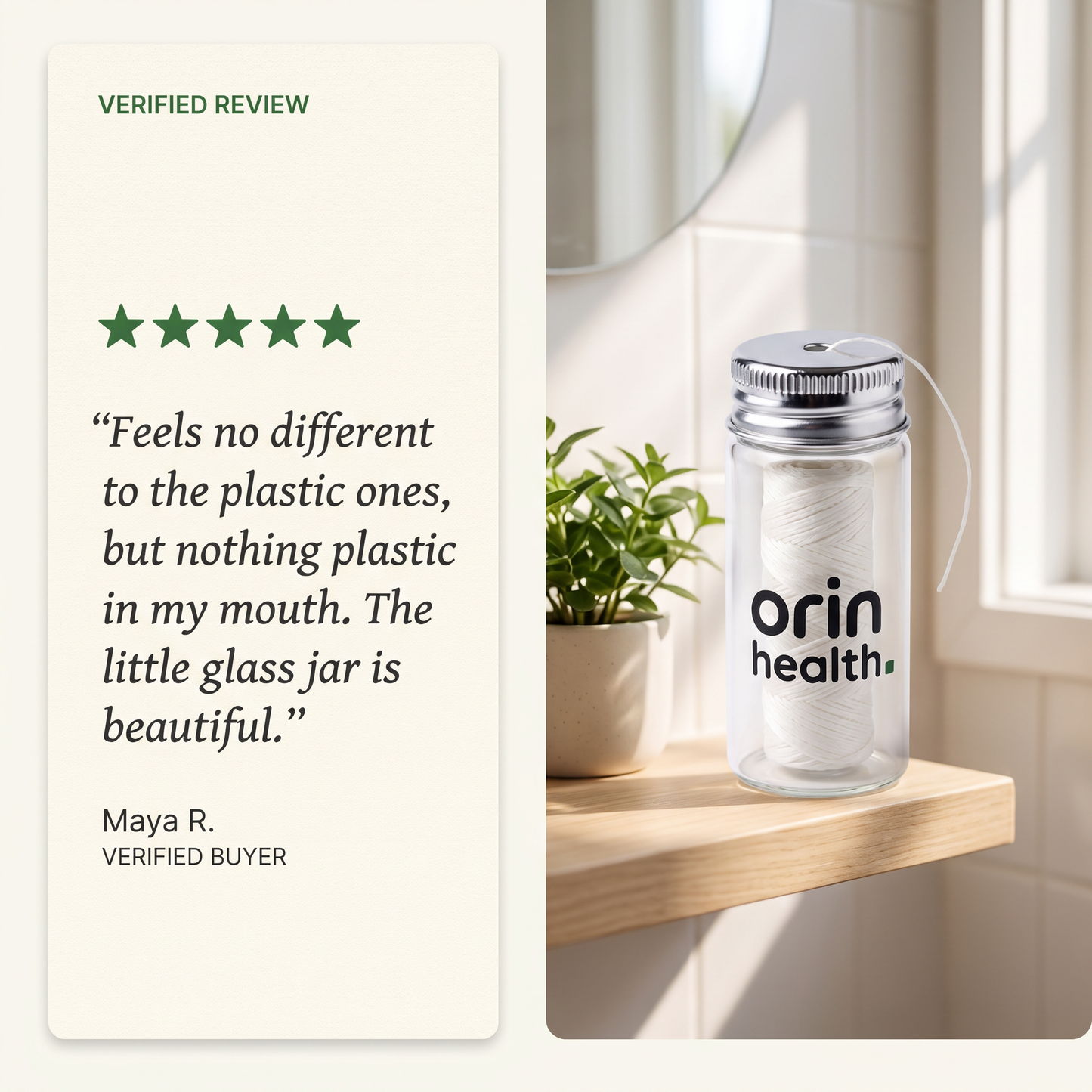
| Container | Refillable glass, metal lid | Plastic spool in a plastic case | Plastic spool in a plastic case | |
| Vegan | No — silk is an animal product | Usually yes | Usually yes |
We are not claiming PTFE floss will harm you — that argument is still being had, and we would rather sell you silk on what it is than on what someone else might be. What we can say is what each one is made of, and what is left when you are done with it.
Four things go in. That's the list.
Most floss packets tell you the flavour and not the fibre. This one is short enough to print in full.
THE PART WE'D RATHER NOT PRINT Not vegan. Silk comes from silkworms and there is no version of this product where it doesn't. If that's a line you hold, hold it — we would rather lose the sale here than have you find out at the bin.
Four steps, and one that sounds like a fault.
Flossing technique is the same whatever the fibre. What changes with silk is the third one.
- Pull about 45 cm. Wind most of it round one middle finger and the rest round the other, so you can feed a clean stretch to each gap.
- Curve it into a C against the side of the tooth and slide it under the gumline. Don't snap it straight down — that's how gums get cut, on any floss.
- Silk is finer than nylon, so it will shred on a rough filling or a chipped edge. That isn't the floss failing. That's the floss finding something.
- Used floss goes in the compost. The glass gets refilled, not binned.
Silk gives way where nylon holds. That is the trade you are making: a fibre soft enough to fray before your gum does.
SO YOU KNOW If it shreds in the same gap every single time, that is worth showing a dentist. Floss is a good early-warning system and a poor treatment.
Five things people ask about silk floss.
Still unsure? Email info@orinhealth.com — a real person answers, usually within a day.
Why does it cost more than a plastic spool?
Because 30 m of mulberry silk costs more to make than 50 m of extruded nylon, and glass costs more than a moulded case. We are not going to pretend otherwise. What you are buying is a shorter roll of a better fibre in a container you keep.
Will it shred?
Sometimes, yes. Silk is finer than nylon and it frays on rough edges — old fillings, chipped enamel, a crown that sits proud. Nylon powers through those spots; silk tells you they are there. If that trade sounds wrong to you, this is the wrong floss and we would rather you knew now.
Is it vegan?
No. Silk is an animal product. If you need a vegan floss, buy a vegan floss — most nylon and PTFE floss qualifies, and we would rather point you there than sell you something you will regret opening.
Does it actually compost?
Silk is a protein fibre and candelilla wax is plant-derived, so both break down. How fast depends on your compost — a hot heap is quick, a cold bin is slow. Put it in the compost, not the recycling: it is too fine for any sorting machine to see.
How long does one vial last?
Thirty metres at roughly 45 cm a session is about sixty-six flosses — call it two months if you floss once a day. Less if you floss twice, or if you are generous with the pull.
Floss handles the gaps. The brush handles the rest.
Kindred is the same idea on a bigger surface: real horsehair or boar on a bamboo handle, nothing synthetic where it touches your teeth. Four brushes a box, one a month.